Myanmar’s Little India
Myanmar’s Zeyawaddy region has over 200,000 Hindus who moved from Bihar in the late 1800’s. They were settled inside a forest area and were asked to clear the area in exchange of huge acres of land

Myanmar’s Zeyawaddy region was in the news on New Year’s Eve after a crossfire between the military Junta and rebel ethnic groups damaged a temple leaving seven dead. This was the first such incident recount Hindus living there who trace their history to the late 1880’s when they relocated (primarily from Bihar) with the promise of land grants which they could farm on and live off.
This temple was damaged during a crossfire on New Year’s Eve:
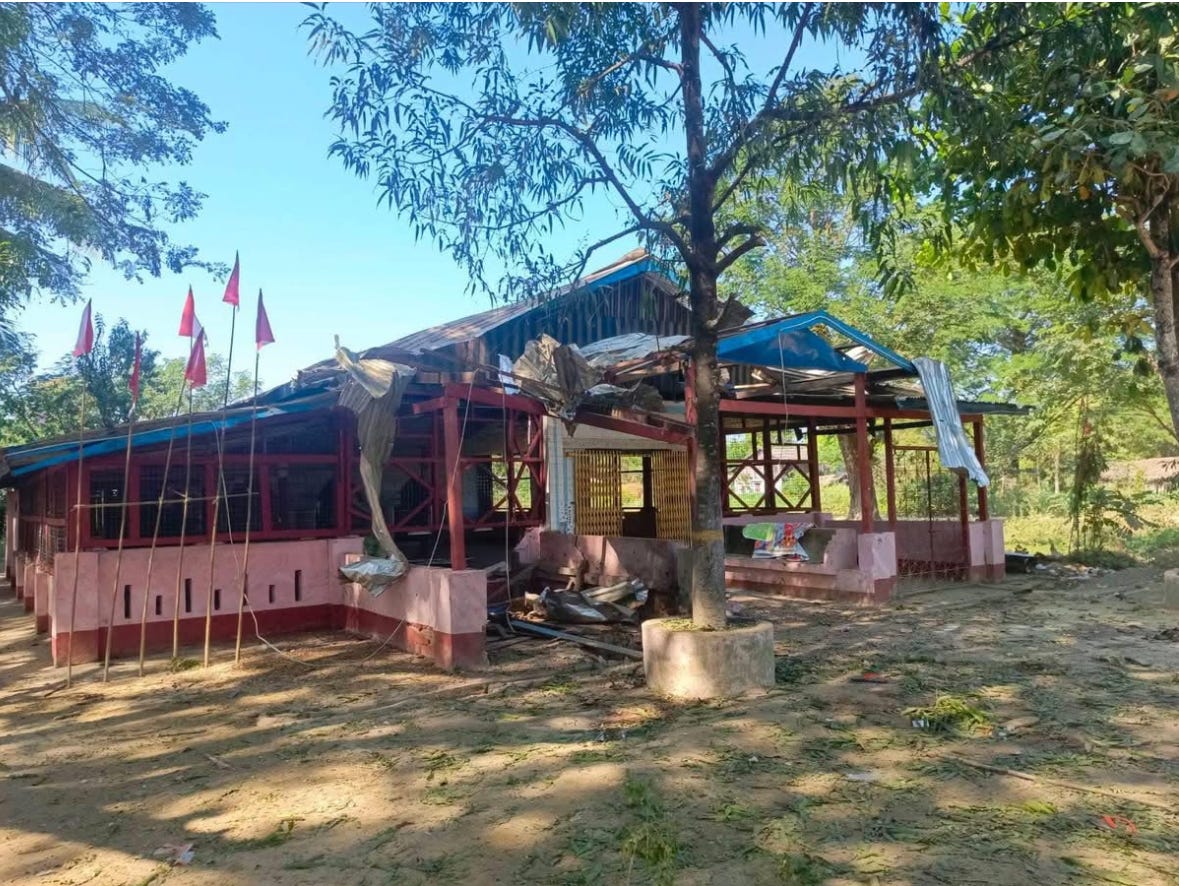
``What happened on this New Year’s Eve was unprecedented as prior to that we never felt unsafe and lived in harmony with the local Buddhists. Our forefathers moved here when the British invited them as settlers and offered them land grants. Rai Bahadur Harihar Prasad Singh (son of Dewan of Bihar’s Dumraon State) took a few hundred Bihari men who were incentivized to clear 18340 acres of land which had been granted by the British. Since it was largely forest land, the labourers had to clear it before they could own it. They began to grow sugarcane and paddy,’’ said Roshan Kumar, an 80-year old resident of Zeyawaddy (real name withheld on request). Kumar was born in Myanmar and his father was amongst the first batch of people who moved there.
This is a picture of Rai Bahadur Harihar Prasad Singh:
During the first phase of migration the selection criteria was simple. Rai Bahadur wanted uneducated men, with a good physique to move there. Educated (which implied even those who could count up to ten) were dropped as they were viewed as potential rebels in the future.
“Educated men, who had any inkling on what this relocation meant or of things happening beyond their villages were not considered. The numbers of migrants increased when the early settlers began to farm on the land they were granted and began to prosper,” Kumar added.
Once the forest land was cleared the Indian migrants were encouraged to grow sugarcane and paddy. Subsequently a sugarcane mill was set up and Rai Bahadur brought it from the British in 1935. This became Myanmar’s largest sugar cane mill with a capacity of 2500 tons annually. This unit was nationalized in 1954, after which Singh returned to India.
The number of Hindus in the Zeyawaddy region (215 kms north of Myanmar’s capital Yangon) at present are 200,000 (out of a total of 890,000 across Myanmar). Hindus form 1.7 per cent of the population and is the fourth largest religion.
``There are over 100 villages in and around Phyu region which has a substantial Hindu settlement and we have maintained our culture and religion. Hindi is being taught in schools, there are temples in nearly all villages and the languages spoken are Hindi, Bhojpuri and Burmese. We also ensure that the girls of our families are educated and independent,’’ Kumar said adding that they celebrate all festivals like Holi, Diwali, Dussehra. Navratri.
Regarding the present situation in Myanmar, the Hindus in Zeyawaddy said that though there is uncertainity at the centre, they don’t have any safety concerns. Dealing with internet and power outages is more of a challenge.
``Even when members of the rebel ethnic groups visit our villages they never intimidate us. They buy products they need and don’t expect gratuities. Notwithstanding that, there is optimism that stability would return to Myanmar. Even though we have origins in India, our home is Myanmar,’’ Kumar added.